

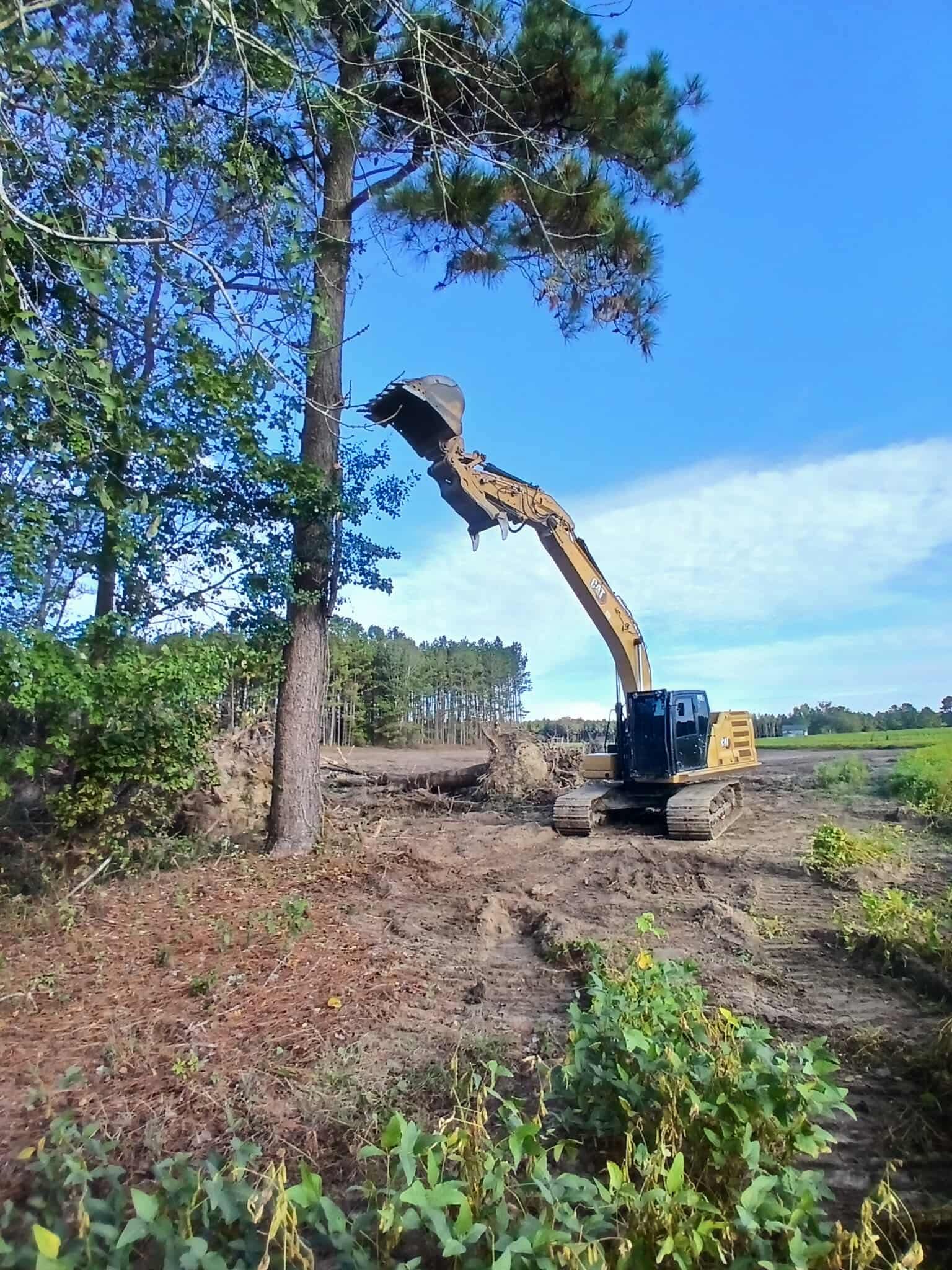
Tree removal in North Carolina costs $150 to $2,000 for most jobs, but the quote you get often hides a second bill: the stump. Here’s what actually drives the price, and the question most homeowners forget to ask before signing.
A property owner in Bunnlevel called us after a storm dropped a 70-foot oak across her driveway. The tree company she’d already hired quoted $1,400, finished the job that afternoon, and left a 30-inch stump sitting in the middle of her gravel drive. Nobody had mentioned the stump wasn’t included. She called three more companies before learning grinding it down would run another $300 to $500. That gap catches people off guard, and it’s the first thing we walk through with every new tree removal client.
How Much Does Tree Removal Cost in North Carolina?
Tree removal in NC typically runs between $150 and $2,000 per tree, with most homeowners paying around $700 to $900 for a standard job, according to Angi’s national tree removal cost data. The price depends mostly on tree height, trunk diameter, and how close the tree sits to a house, fence, or power line.
Here’s a quick breakdown by size:
| Tree Height | Typical Cost |
| Under 30 feet | $150 – $400 |
| 30–60 feet | $400 – $700 |
| 60–80 feet | $900 – $3,000 |
| 80+ feet (crane needed) | $3,000 – $9,000+ |
Did You Know? A tree leaning toward your house costs more to remove than the same tree in an open yard, even at the same height. Crews need extra rigging to control the fall direction, which adds labor time.
Species matters too. Pines come down faster than hardwoods because the wood is lighter and the canopy is narrower. A 60-foot pine and a 60-foot oak rarely cost the same to remove, since the oak’s dense wood and wide canopy mean more cuts and more cleanup.
What’s Actually Included in a Tree Removal Quote
Most tree removal quotes cover felling the tree, cutting it into sections, and hauling away debris. What they usually don’t cover is the stump. That’s billed separately almost everywhere in North Carolina, and it’s the detail that trips up the most homeowners.
Pro Tip: Before you sign anything, ask three questions directly: Does this price include stump removal? Does it include hauling wood and brush off-site? And is the quote based on an in-person look at the tree, or just a phone estimate? A phone number almost always changes once a crew sees the site.
Stump Removal vs. Stump Grinding: What’s the Difference?
Stump grinding and stump removal solve the same visual problem but leave different results behind. Knowing which one you need can save hundreds of dollars.
Stump grinding uses a machine to chew the stump down to 6 to 12 inches below ground level. It’s the faster, cheaper option, typically $2 to $5 per diameter inch, with most jobs landing between $150 and $500. The wood chips can be hauled away or left to break down. The root system stays in the ground, which is fine for most yards but can cause problems if you’re building, paving, or planting in that exact spot.
Stump removal pulls the entire stump and root ball out of the ground. It costs more, usually $250 to $1,500 depending on size and root depth, since it involves more digging and often leaves a hole that needs fill and leveling. This is the right call if you’re putting in a driveway, foundation, or new planting bed where old roots would interfere.
Did You Know? A buried stump doesn’t disappear, it decomposes. As the wood breaks down over several years, the ground above it sinks, which is why stumps pushed into a hole and covered instead of properly ground or excavated tend to cause sunken spots years later.
| Stump Grinding | Stump Removal | |
| Typical cost | $150 – $500 | $250 – $1,500 |
| Roots removed | No | Yes |
| Speed | 1–2 hours per stump | Half day to full day |
| Best for | Lawns, general cleanup | Building, paving, replanting |
When Tree Removal Becomes an Emergency
Not every tree comes down on a schedule. North Carolina’s storm season turns healthy-looking trees into overnight hazards, and knowing the difference between “needs attention soon” and “call right now” matters.
A tree needs emergency removal if it has already fallen on a structure, vehicle, or power line, if it’s leaning at a new angle after a storm, or if a large limb has split and is hanging rather than fully detached. Stay clear of the area and call a professional immediately, especially near downed power lines.
A tree should be scheduled soon, but isn’t a true emergency, if you’re noticing dead branches throughout the canopy, fungus at the base, or a hollow sound when you tap the trunk. These are warning signs the tree is declining, not proof it’s about to fall today.
Pro Tip: If a storm just came through and you’re not sure whether a tree is structurally compromised, take photos from multiple angles before calling anyone. It helps the contractor assess risk over the phone and prioritize true emergencies over routine cleanup.
Permits and Regulations for Tree Removal in North Carolina
Most residential tree removal in North Carolina doesn’t require a permit, but there are exceptions worth knowing before you start cutting.
If the tree is within 10 feet of an energized power line, North Carolina’s Overhead High-Voltage Line Safety Act requires the utility company to be involved before work begins. Skipping this step is a real safety risk. Clearing multiple trees as part of a larger land-disturbing project over one acre falls under separate erosion control rules.
Some cities protect older or large-diameter trees, so it’s worth a quick call to your local planning office before removing one inside city limits. Unincorporated areas of Cumberland and surrounding counties have fewer tree-specific rules, but utility line requirements apply everywhere.
How to Choose a Tree Removal Contractor
Price matters, but it shouldn’t be the only thing you compare. A quote far below everyone else’s often means skipped insurance or stump removal left out entirely. Ask whether the company is licensed and insured, whether the price is per tree or flat for the whole job, and whether cleanup is included.
If your project involves more than a tree or two, like an overgrown lot you’re getting ready to build on, you may needland clearing services instead of individual tree removal. Land clearing handles brush, multiple trees, and stumps as one project, which usually costs less at scale.
What Happens After the Tree Comes Down
Once a tree and its stump are gone, most properties need at least minor ground work to look finished. A noticeable hole from stump removal needs fill dirt and grading to level back out, which connects to grading and site preparation for anything beyond a small dip.
If the tree was part of a larger overgrown section, forestry mulching is often more cost-effective than removing trees one at a time. Forestry tilling services grind brush and smaller trees into the soil in a single pass, useful for reclaiming a few acres at once.
Frequently Asked Questions
How much does it cost to remove a tree in North Carolina?
Most tree removal jobs in NC cost between $150 and $2,000, with $700 to $900 being typical for a mid-sized tree. Height, trunk diameter, and proximity to structures or power lines are the biggest factors driving the final price.
Does tree removal include stump removal?
Usually not. Most NC tree companies bill stump grinding or removal separately, adding $150 to $1,500 depending on size and method. Confirm this before signing a quote.
What is the difference between stump grinding and stump removal?
Grinding chews the stump down below ground level but leaves the roots intact. Removal excavates the entire root ball. Grinding is cheaper and faster; removal is necessary if you’re building, paving, or planting on that spot.
Do I need a permit to remove a tree in North Carolina?
Most residential tree removal doesn’t require a permit, but trees within 10 feet of power lines require utility company involvement under state law. Some cities protect large or historic trees, so check with local planning if you’re inside city limits.
How do I know if a tree needs emergency removal?
A tree needs emergency attention if it has already fallen on a structure or power line, is visibly leaning after a storm, or has a large limb hanging by a thread. Dead branches or fungus at the base are warning signs to schedule removal soon, but they’re not usually a same-day emergency.
Get a Free Tree Removal Estimate
A reliable quote starts with someone actually looking at the tree, not guessing over the phone. Height, species, proximity to structures, and stump condition all change the price.
3B Site Development offers free property assessments across central North Carolina, including Fayetteville, Bunnlevel, and Raleigh. Request your free estimate today and get a written, no-pressure quote within 24 hours.