

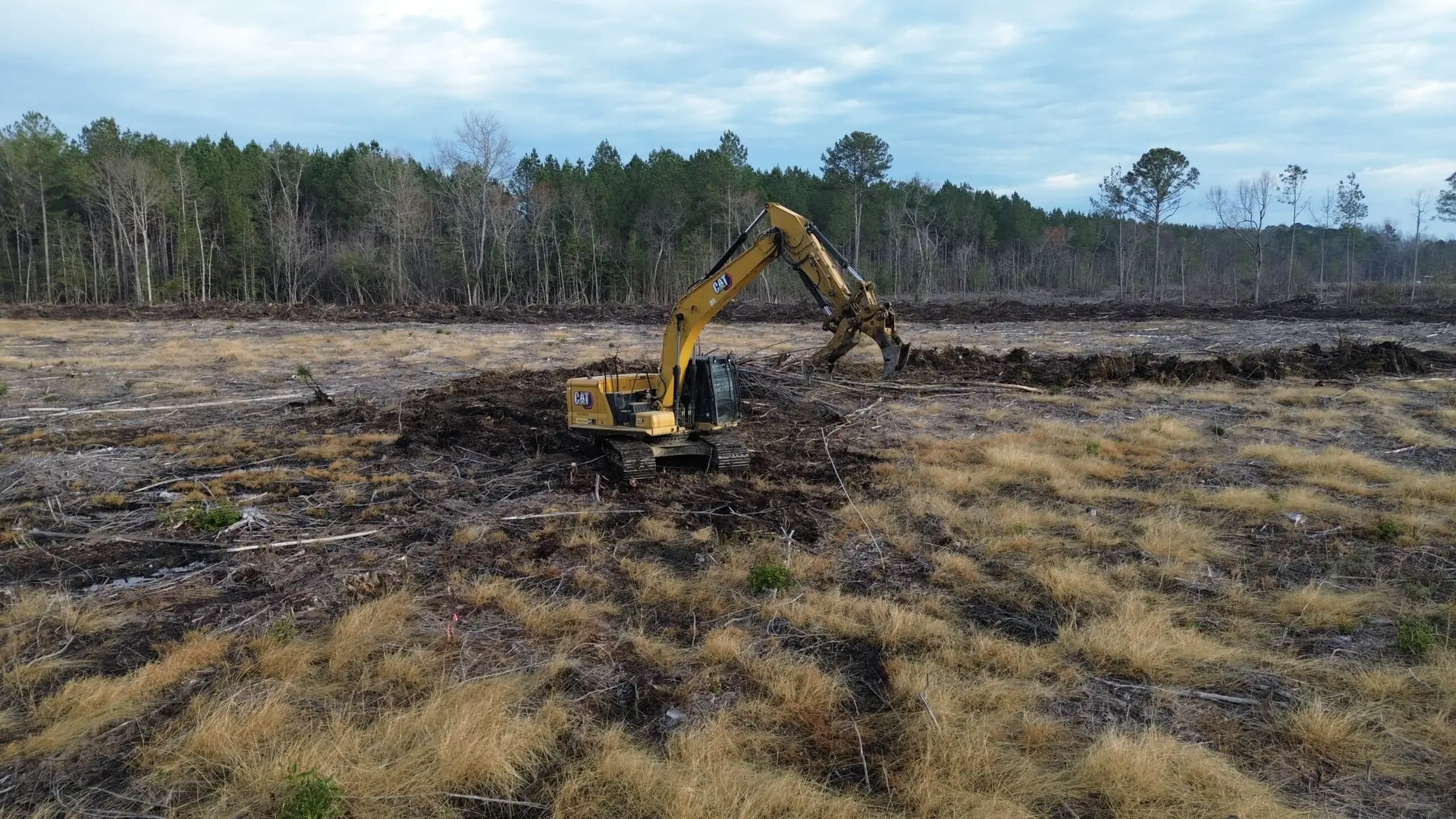
Land grading in North Carolina costs $1 to $2 per square foot for most residential projects — but the price is rarely the problem. The bigger risk is skipping it, rushing it, or hiring a crew that treats every property like a flat parking lot. Here’s what proper land grading actually involves, and why it matters before a single board gets nailed.
We got a call from a homeowner in Fayetteville whose builder had “finished” grading two years prior. Water was pooling against the foundation, the crawlspace smelled like mildew, and the backyard turned into a pond after every rain. The problem was straightforward: the grade sloped toward the house instead of away from it. Everything above ground looked fine. The subgrade told a different story — and fixing it after construction costs five to ten times what it would have cost to get it right the first time.
What Is Land Grading?
Land grading is the process of reshaping the soil on a property to achieve proper drainage, a stable foundation, or a level surface for construction. It’s not just “moving dirt around.” Done correctly, grading controls where water goes, how the soil settles under a building, and whether your site will hold up through North Carolina’s wet springs and summer storms.
What does land grading involve? Land grading involves excavating high areas, filling and compacting low areas, and sloping the finished surface away from structures — at minimum 6 inches per every 10 feet from the foundation, per standard construction requirements. It typically involves a bulldozer for rough work and a skid steer or box blade for finish grading. A perfectly smooth finish grade on an improperly roughed site will still fail.
How Much Does Land Grading Cost in North Carolina?
How much does land grading cost? Land grading costs $1 to $2 per square foot for most residential projects in NC, working out to $800 to $2,000 for a 1,000 square-foot area and up to $45,000 for a full acre, according to Angi’s land grading cost data. Most residential jobs fall well below the one-acre mark.
Here’s how the costs break down by typical project scope:
| Project Type | Typical Cost |
| Backyard re-sloping (500–1,500 sq ft) | $500 – $2,500 |
| Foundation grading around a home | $1,000 – $3,000 |
| Full lot grading (pre-construction) | $3,000 – $15,000 |
| Multi-acre site prep | $15,000 – $45,000+ |
Did You Know? Soil type is one of the biggest cost variables in NC grading. Sandy coastal plain soils are far easier to move and compact than the dense clay common around Fayetteville and Raleigh. That difference alone can shift project cost by 20% or more on the same lot size.
Rocky terrain adds $200 to $1,200 above base pricing. Sites needing fill dirt add $5 to $25 per cubic yard for material and hauling on top of labor.
What Affects Your Final Grading Quote
A few factors move estimates up or down substantially:
Slope degree: A yard with a 3-foot drop across 50 feet is manageable. A site dropping 10 feet across the same distance needs far more earthmoving, compaction layers, and possibly retaining structures.
Existing vegetation and debris: If trees or stumps are still on the site, those need to come out before grading can begin. Land clearing in North Carolina typically runs before grading, and the two are often bundled on larger projects.
Equipment access: Tight lots or fenced backyards may require smaller machines, which cost more per hour.
Pro Tip: Get your grading and land clearing quotes together. Contractors often discount the combined scope, and a single crew handling both phases eliminates the coordination gap where clearing debris ends up blocking the grader.
When Do You Need Land Grading?
Not every project needs a full grade. Here’s when it’s a key part of the work:
You need grading before: new home construction; driveway installation on uneven ground; patio or deck footings; major landscaping changes that alter drainage; or when runoff is pooling against a foundation.
You may not need full grading for: replacing a deck on a level site, adding a shed on pre-leveled ground, or routine lawn maintenance.
Did You Know? NC’s Sedimentation Pollution Control Act requires an erosion and sedimentation control plan and permit for anyone disturbing one acre or more of land — whether that’s clearing, grading, or excavation. Most residential projects under an acre won’t trigger this at the state level, but municipalities like Raleigh set the bar lower, requiring a land disturbance permit at just 12,000 square feet of disturbance. If your project is close to either threshold, check with your local planning office before breaking ground.
Grading for Drainage vs. Grading for Construction
These are related but different goals, and confusing them leads to projects that look done but don’t function.
Drainage grading redirects water away from structures toward appropriate outlets — a swale, storm drain, or natural slope. The goal is preventing standing water, foundation moisture, and soil erosion. Good drainage grading manages flow during a heavy storm, not just a light rain. The contractor needs to understand where water comes from, where it goes now, and where it needs to end up.
Construction grading creates a stable, compacted sub-base for a building pad, driveway, or other permanent structure, requiring precise elevation matching to the structure’s plans.
Both types often happen together. A house pad needs construction-quality compaction below grade and drainage-quality slope above grade.
Pro Tip: Heavy clay soil — common in Harnett and Cumberland County — holds water rather than letting it drain. A contractor who doesn’t account for clay behavior during finish grading will leave you with a beautiful yard that floods every time it rains. Ask specifically how they handle clay subgrades before you book.
How Site Grading Fits Into the Full Site Prep Process
Grading doesn’t happen in isolation. It’s one step in a sequence, and that sequence matters.
Step 1: Land Clearing.
Trees, brush, and stumps come out first. Grading around existing vegetation leaves unstable root zones that cause settling later. If trees are part of the clearing scope, it’s worth understanding what tree removal costs in NC before bundling services, since pricing varies by size and species. For heavily wooded sites, forestry tilling grinds brush and small trees into the soil before the grading crew arrives.
Step 2: Rough Grading.
Excavators and bulldozers establish the general elevation and slope, cutting high spots and filling low areas with compacted soil lifts.
Step 3: Utility and Drainage Infrastructure.
Underground pipes, French drains, or utility lines go in before the final surface is set.
Step 4: Finish Grading.
A finer pass creates the precise surface profile the builder, concrete crew, or landscaper will work from.
Step 5: Erosion Control.
Erosion control services — silt fencing, seeding, or erosion matting — protect the finished grade while vegetation establishes.
A properly graded sub-base is the single biggest factor in driveway construction durability. Skip this step and even a well-built driveway will develop ruts and washouts within a few seasons.
What to Ask a Grading Contractor Before You Hire
Most grading problems come down to inadequate compaction or improper slope. Ask how the contractor establishes final grade elevation — laser-guided systems are the standard, not eyeballing. Ask whether they compact in lifts or just once at the surface. Ask who owns drainage compliance: the grading contractor, the builder, or you. Also confirm debris removal: some contractors leave spoils on site and charge extra to haul them away.
Frequently Asked Questions
What is land grading and why is it important? Land grading reshapes the soil on your property to control drainage, stabilize foundations, and create a level surface for construction. It’s the step that determines whether water flows away from your home or toward it — and whether the ground under a structure will hold over time.
How much does land grading cost in NC? Most residential grading projects in North Carolina cost between $1 and $2 per square foot. A standard backyard regrading runs $500 to $2,500; full lot grading ahead of new construction typically ranges from $3,000 to $15,000 depending on size, slope, and soil conditions.
Do I need a permit for land grading in North Carolina? Projects disturbing one acre or more require an erosion and sedimentation control plan under NC state law. Several municipalities — including Raleigh — require a land disturbance permit for projects disturbing 12,000 square feet or more. Check with your local planning office before starting any significant grading.
How long does land grading take? Backyard regrading typically takes one to two days. Full lot grading for new home construction runs three to five days depending on size, slope, and whether clearing is needed first. Multi-acre sites may take one to two weeks.
What’s the difference between rough grading and finish grading? Rough grading handles major earth movement, cutting high areas and filling low ones to approximate the final elevation. Finish grading is a finer pass creating the precise surface the builder or landscaper works from. Both are required for construction-grade site prep.
Get a Free Grading Estimate for Your NC Property
Proper land grading is the foundation every other project on your site depends on — and getting it wrong costs far more to fix than to do right the first time.
3B Site Development provides free property assessments across central North Carolina, including Bunnlevel, Fayetteville, and Raleigh. Contact our team today for a written estimate and a straight answer on what your site needs before work begins.